 Go Back

How AI is Transforming Disease Management: Insights from Google Research
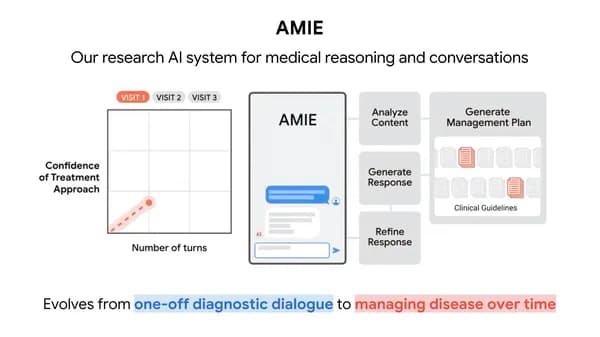
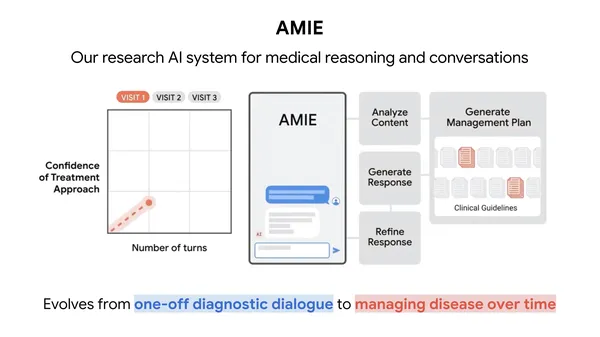
Recent research published in Nature has highlighted a groundbreaking development in the field of healthcare: Google's conversational AI system, AMIE, has shown it can match primary care physicians in complex disease management. This innovation marks a pivotal moment where artificial intelligence is not just a support tool but a potential game-changer in patient care.
Quick Take
| Aspect | Details |
|---|---|
| AI System | AMIE |
| Domain | Disease Management |
| Comparison | Matches Primary Care Physicians |
| Research Publication | Nature |
| Potential Impact | Healthcare Efficiency, Cost Reduction, Accessibility |
Market Context
The integration of AI in healthcare is not merely an experimental phase anymore; it has become a necessity for efficient disease management. As the global healthcare landscape grapples with rising costs and increased patient load, solutions like AMIE are crucial.
Historical Perspective
Historically, the healthcare sector has been slow to adopt technological innovations due to regulatory constraints, the complexity of medical practices, and a general hesitance to compromise on patient care. However, in recent years, advancements in machine learning and data processing have accelerated the development of AI applications in this field. The COVID-19 pandemic acted as a catalyst for digital transformation, pushing for more AI solutions in patient management and diagnosis, which have now laid the groundwork for innovations like AMIE.
Current Trends
The rise of telemedicine and digital health platforms has made it easier for AI technologies to integrate into routine healthcare processes. As healthcare providers become more familiar with these technologies, the market for AI-driven solutions is expected to grow exponentially. This presents a robust opportunity for investment in companies developing AI solutions tailored to healthcare needs.
SWOT Analysis
Strengths
- Efficiency: AMIE’s ability to match primary care physicians signifies a potential increase in efficiency in managing complex health issues. This can lead to quicker diagnosis and treatment plans.
- Cost-Effective: By automating certain aspects of patient management, healthcare facilities can reduce operational costs significantly.
- Scalability: AI systems can be more easily scaled compared to hiring additional human resources, thereby addressing staffing shortages in healthcare sectors.
Weaknesses
- Trust and Adoption: The medical field is inherently conservative; there may be reluctance among healthcare professionals to rely on AI for patient management due to trust issues.
- Data Privacy Concerns: Handling sensitive medical data raises significant privacy issues, with stringent regulations like HIPAA creating barriers to implementation.
Opportunities
- Expanding Market: As healthcare moves towards value-based care, there is an increasing demand for efficient management solutions that can lower costs without sacrificing quality.
- Global Reach: AMIE can be adapted for use in underserved regions where access to healthcare is limited, thereby improving global health outcomes.
Threats
- Regulatory Hurdles: The healthcare industry is heavily regulated, and any AI solution must navigate complex legal frameworks.
- Technological Obsolescence: The rapid pace of technological advancement could render current solutions obsolete if continuous updates and adaptations are not prioritized.
Impact on Investors
The AI healthcare market is poised for significant growth in the coming years. Investors focusing on healthcare technology should pay close attention to developments like those from Google’s AMIE. Here are some key factors to consider:
Investment Opportunities
- Emerging Technologies: Companies that are developing similar AI systems could be ripe for investment as the healthcare sector continues to integrate AI into its frameworks.
- Public-Private Partnerships: Collaborations between tech companies and healthcare providers can lead to innovative solutions and present investment opportunities.
Long-Term Outlook
The future of AI in healthcare appears promising. As technologies advance, AI will likely play a more significant role, not only in disease management but also in predictive analytics, patient monitoring, and personalized medicine. This opens up a vast array of investment avenues for venture capitalists who are willing to engage with innovative companies in this space.
In conclusion, Google's AMIE represents more than just a technological advancement; it signifies a shift in how healthcare can leverage AI for improved patient outcomes. For investors, the implications are clear: engage with this growing sector now to capture the benefits of a revolution that is just beginning to unfold.